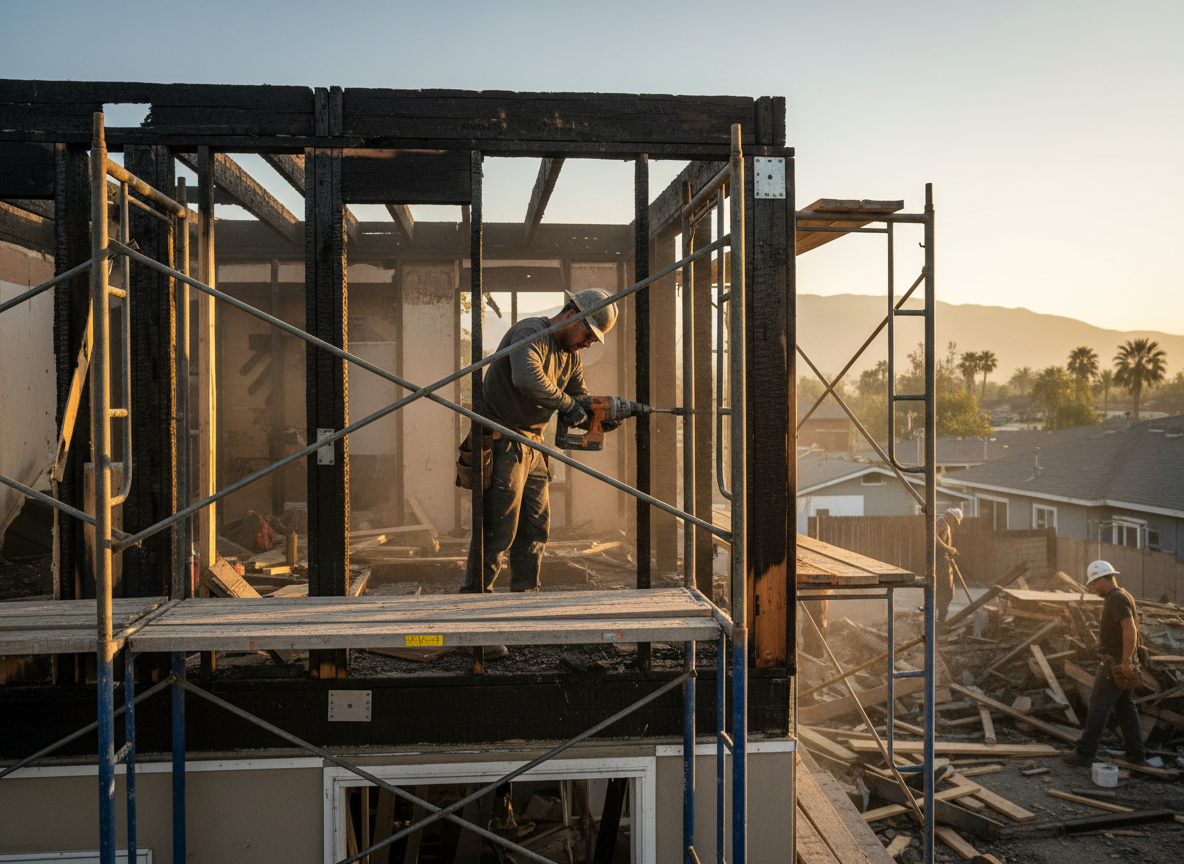
Granada Hills and Knollwood contain many mid-century wood-framed houses with stucco exteriors and attic spaces that trap heat and smoke. After a fire, charred joists and rafters often lose load capacity even when surface damage looks limited. Hot summer temperatures accelerate drying of residual moisture from suppression efforts, which can cause hidden cracking in plaster and drywall before repairs begin. Technicians must evaluate connections at the foundation and roofline where older construction used less robust hardware than current standards require.
Los Angeles County building codes mandate specific fire-resistant materials when replacing structural members in these neighborhoods. Crews remove all charred wood beyond the visible burn line because embers can remain active in dry Mediterranean conditions. Replacement lumber is pressure-treated or coated for added protection, and new sheathing is installed to restore shear strength. Work near O'Melveny Park or Granada Hills Recreation Center often involves coordinating with hillside slope setbacks that affect scaffolding and material staging.
Electrical and plumbing runs embedded in walls must be inspected and often rerouted after fire exposure, since heat can degrade insulation and fittings. Final inspections verify that repaired sections meet current seismic and fire-code requirements before finishes are applied. Homeowners in Porter Ranch and Mission Hills frequently request the same approach when fires originate from nearby canyons during Santa Ana wind events.
Technician insight
In Granada Hills the thing that catches most people out with structural repair after fire is how quickly residual moisture from suppression evaporates in our hot summers, leaving hidden splits in older rafters that only show up once drywall is opened near Knollwood homes.
Knollwood Attic Joist Replacement
A kitchen fire in a 1960s Knollwood house left several ceiling joists heavily charred. Inspection revealed heat damage extended beyond the visible area into the attic. Crews shored the roof, removed compromised members, and installed new fire-rated joists with updated hardware. The structure passed Los Angeles County inspection and was returned to service.
How it works
- 1
On-Site Structural Assessment
Inspect framing, load paths, and hidden damage throughout the affected areas of the Granada Hills property.
- 2
Permit and Code Review
Submit plans to Los Angeles County and confirm all replacements meet current fire and seismic standards.
- 3
Selective Demolition and Shoring
Remove compromised members while installing temporary supports to maintain structural integrity.
- 4
Material Replacement and Reinforcement
Install new fire-rated lumber, connectors, and sheathing, then verify load capacity.
- 5
Final Inspection and Finish Prep
Obtain county sign-off and prepare surfaces for subsequent restoration work.
Pricing
Upfront written estimates provided after inspection; final cost depends on extent of hidden damage and required code upgrades.