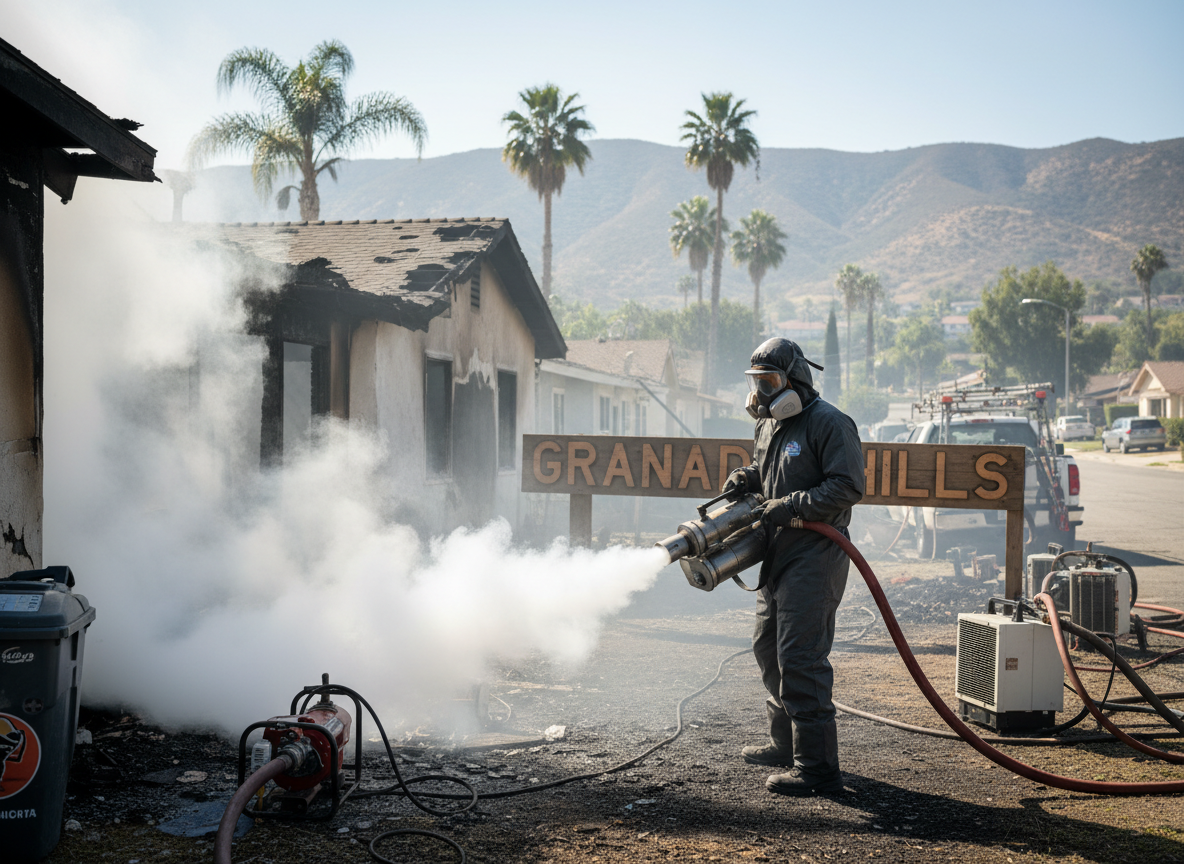
Granada Hills homes built before the 1980s often feature stucco exteriors and plaster interiors that absorb smoke deeply, especially in neighborhoods near O'Melveny Park where hillside winds push soot into wall cavities. Warm Mediterranean summers accelerate odor re-release through air conditioning systems, while mild winters reduce natural ventilation and let residues settle in attics. Effective removal requires distinguishing between surface soot and embedded hydrocarbons in porous materials like drywall, carpet padding, and insulation common throughout Knollwood and adjacent Northridge streets.
Technicians begin by mapping airflow paths created by the home's original HVAC layout, then apply thermal fogging or hydroxyl generators sized for the square footage rather than generic room counts. In Porter Ranch and Mission Hills properties with slab foundations, concrete can retain odors for months if not treated with penetrating sealers. Homeowners sometimes attempt ozone alone, which masks rather than neutralizes residues and can damage electronics or fabrics when left running too long in enclosed spaces typical of Granada Hills tract homes.
Los Angeles County building codes require verification that combustion byproducts are below detectable levels before re-occupancy, particularly after fires involving modern synthetics that produce more persistent VOCs. Crews document each step with moisture meters and particle counters to avoid callbacks when summer heat returns and drives remaining odors out of subflooring. Properties near the Granada Hills Recreation Center frequently need extra attention to garage-to-living-space transitions where vehicle-stored flammables create layered smoke profiles.
Technician insight
In Granada Hills the thing that catches most people out with odor removal after fire is how the warm summers and older plaster walls near O'Melveny Park keep pushing smoke back into living spaces weeks after the initial cleanup. Homeowners often skip the HVAC ducts because they look clean, yet those ducts are exactly where the next heat wave reactivates the smell.
Lingering Smoke in Knollwood Residence
A fire in a 1970s stucco home near Granada Hills Recreation Center left smoke in the walls and ducts. Inspection showed residues concentrated in the original plaster and attic insulation. Crews removed affected materials, treated the HVAC, and applied targeted oxidizers. Air tested clear and the family returned without recurring odors during the following summer.
How it works
- 1
Initial Assessment
Inspect all affected rooms, HVAC runs, and hidden cavities using meters to locate trapped smoke in Granada Hills construction.
- 2
Source Removal
Clean or remove porous materials such as insulation and carpet that hold odors in older Knollwood homes.
- 3
Air Treatment
Deploy appropriate oxidizers or foggers calibrated for the home's volume and local climate conditions.
- 4
Verification
Test air quality and surfaces until odors are undetectable before final clearance.
Pricing
Cost depends on square footage, number of affected rooms, and whether HVAC cleaning is required.