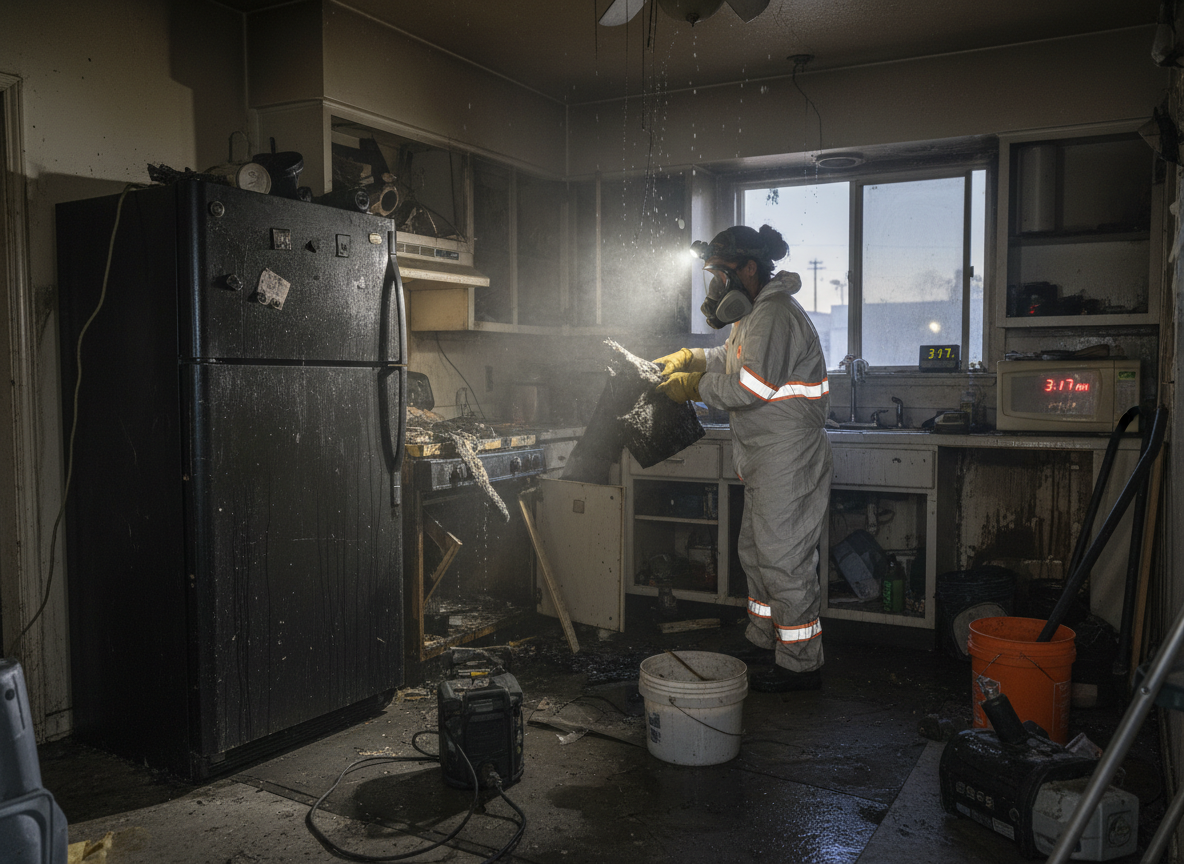
Granada Hills homes built in the 1950s through 1970s often feature wood framing and lath-and-plaster walls that trap soot deep into cavities when a fire occurs. In the warm Mediterranean climate, hot dry summers and occasional Santa Ana winds push smoke farther into attics and wall spaces than in coastal Los Angeles County neighborhoods. Our 24 hour fire restoration crews respond from 11118 Balboa Blvd and begin by isolating affected zones to stop cross-contamination into unaffected rooms.
Knollwood properties sit on sloped terrain near O'Melveny Park where embers can travel upslope and reignite in dry brush. This means hidden charring under eaves and in crawl spaces is common even after the main fire is out. We use thermal imaging to locate these pockets before demolition because standard visual checks miss them in older single-story ranches typical of the area.
Smoke from synthetic materials in Mission Hills and Porter Ranch homes leaves acidic residues that etch metal ductwork and electrical boxes if left untreated. Our process includes neutralizing these residues on HVAC systems that run continuously in Granada Hills summers. Delaying treatment allows corrosion to spread into neighboring Northridge homes through shared attic spaces.
Los Angeles County building codes require permits for any structural member replacement after fire. We document every charred joist and coordinate inspections so work does not stall while residents stay in hotels. This documentation also protects owners when insurance adjusters question the scope in older Granada Hills housing stock.
Technician insight
In Granada Hills, the thing that catches most people out with 24 hour fire restoration is how the dry summer air and older lath-and-plaster walls let smoke travel into Knollwood attics even when the fire stayed in one room near O'Melveny Park. Homeowners often think wiping surfaces is enough, but the soot stays acidic and corrodes wiring if the cavities are not opened and treated.
Attic Fire Spread in Knollwood Ranch Home
Smoke from an attic electrical fire migrated through a 1962 Granada Hills home. We found heavy soot residue inside HVAC ducts that fed multiple bedrooms. Crews sealed and cleaned the system, removed affected insulation, and restored airflow without odor return after two weeks of monitoring.
How it works
- 1
Emergency Board-Up And Site Security
Secure openings and tarp roofs within the first hours to prevent weather intrusion common during Granada Hills winters.
- 2
Soot And Smoke Mapping
Use air sampling and thermal cameras to trace smoke paths through older plaster walls and attic spaces typical in Knollwood.
- 3
Contents Removal And Cleaning
Pack out salvageable items and treat them off-site to avoid re-soiling during structural work.
- 4
Structural Drying And Odor Removal
Apply hydroxyl generators and sealants suited to the dry local climate before reconstruction begins.
- 5
Final Clearance And Rebuild Coordination
Pass county inspections and return the home to pre-loss condition with documented photo logs.
Pricing
Costs depend on fire size, smoke migration through older homes, and whether HVAC cleaning or structural repairs are needed; we provide upfront written estimates after inspection.